As unlikely as it seems, there have been occasions when I notice some damage on a customer’s guitar that they are unaware of. You would think that they’d know every inch and aspect of their guitar whether they’ve had it for years or just bought it from a seller on eBay but it isn’t the case.
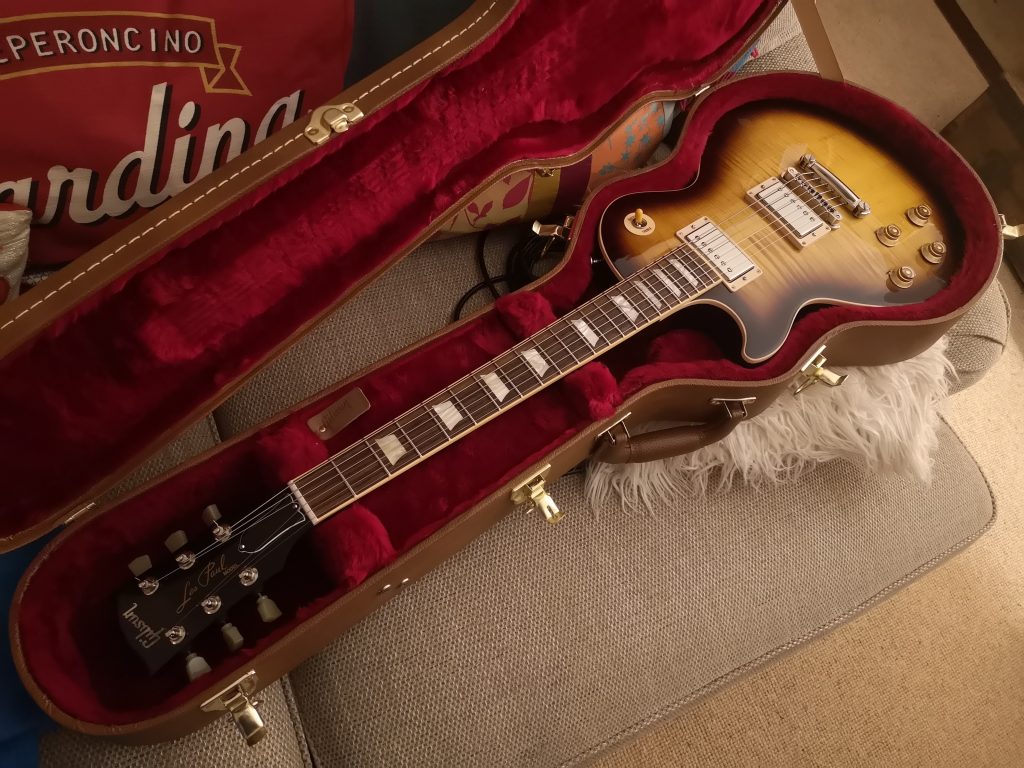
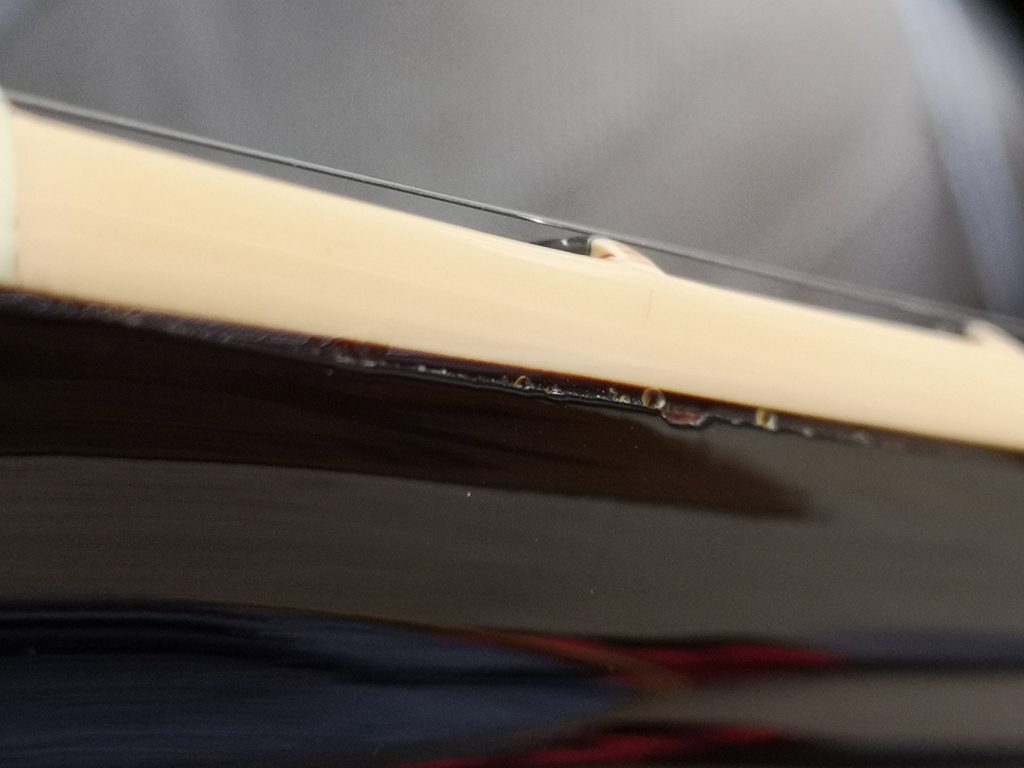
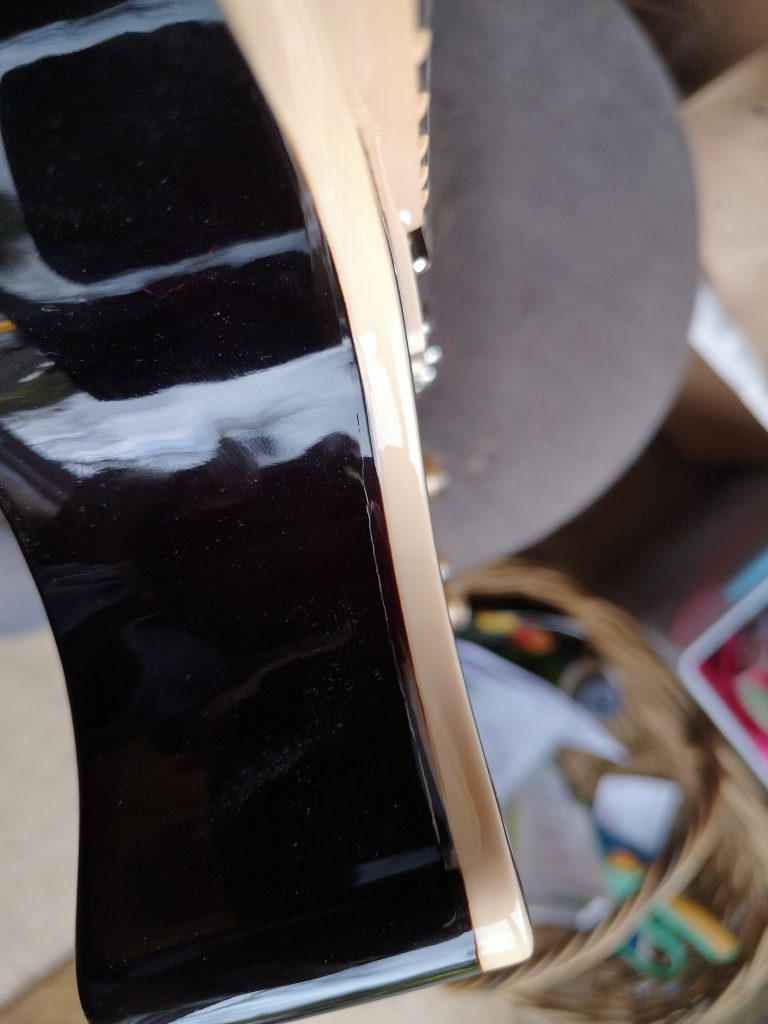
This happened to me at the weekend. I met a customer to collect his Gibson Les Paul and brought it home. Later that evening I took the guitar out of its case to check it over prior to taking it to the workshop for its set up and my fingers detected something amiss with the finish on the neck, on the treble side near the nut. It felt like a raised area; a bulge and although it wasn’t huge it was enough to know that if it was my guitar, I’d feel it every time I played it. On close examination, I found a 2″ long crack in the finish just under the binding and another fine crack about 3″ long inside the cutaway curve, also just under the binding.
After mulling it over for a while, my best guess was that in both places the cracking finish was caused by essentially the same problem: different glued timbers coming slightly apart. On the neck near the 1st fret the crack line was along the join between the rosewood and the underlying mahogany. In the cutaway curve the crack was along the line between the maple cap and the underlying mahogany of the body. Both cracks were visible due to the finish cracking and chipping but it was impossible for me to ascertain the condition of the wood underneath. However, if I’m right and both cracks were due to inadequate glueing and a slight parting of the timbers – then the owner has a fairly expensive repair bill looming if he wants to fix this and retain the guitar’s resale value.
I don’t know the history of this guitar, other than that my customer bought it 2nd hand recently. Why he missed these cracks when buying isn’t clear to me nor (assuming he bought this from somewhere like eBay or Reverb) why he didn’t ask for a refund straight away from the seller. That’s not really any of my business.
What IS my business is the situation that finding an unexpected fault on a guitar leaves me in. The options open to me are either to say nothing and do the set up work I was asked to do or to point the problem out to my customer and offer my recommendation as to remedial action. Not mentioning it is out of the question as far as I’m concerned – in part because if you don’t mention it there’s a chance that the customer will suddenly notice it when he or she gets the guitar back from you and think that the damage occurred in your care!
Honesty is always the best policy – not least because customer trust depends on it. But don’t expect your customer to feel good about it: the fact is that you’ve just peed on what, up until that point, had been a very sunny parade. Sure, they’ll be grateful that you told them your findings… but they’ll still be unhappy because out of the blue their guitar is now going to cost them a few hundred more pounds just to regain it’s market value. If they can get a refund then that’s good news for them but bad news for you as you’ll be boxing it back up without earning the set up fee you might be counting on in these difficult times.
So if you find yourself in this position, take lots of pictures and contact your customer immediately to show and explain to them what you found. Don’t expect a ‘thank you’; not because your customer’s a bad person but because they’re dealing with how THEY feel about not spotting this problem and having a less-than-market value guitar that will now annoy them every time they play it, not thinking about how you feel. And if they DO send the guitar back for a refund, don’t expect them to pay you for the time you spent picking up and assessing the guitar or the time spent taking pictures, doing research and writing detailed emails explaining the problem. Again, not because they’re villains but simply because they’re too busy dealing with their loss and the inconvenience it has caused them to stop and consider what it’s cost you. In this situation the only thing you can do is to make a decision: are you going to write off the time and effort already spent or are you going to ask for a fair fee? If you’re prepared to write it off the challenge will be to not feel bad about it. If you are going to ask for a fair fee, then you’re going to need to be assertive. Being assertive means being very clear with your customer (‘although the circumstances changed and I didn’t do the set up work we originally planned, I DID do the following which took time, expertise and effort…’). Calm, respectful assertiveness is an act of self-respect and worth practicing at every possible opportunity!
If it all sounds a bit complicated and nuanced it’s because, well, communication, honesty and assertiveness IS. So many good guitar techs and luthiers fall down on their customer service because they lack assertiveness and shy away from being completely honest – particularly when they themselves have make a mistake. In this case the customer, despite sounding quite unhappy in his emails and at one point considering coming to collect the guitar right away without having the set up work done, ultimately agreed to having that work done and I made my fee.
As it is I’m looking forward to doing the set up tomorrow and making the guitar play as well as it can (in this case clearing up some fret buzz and high bends that are currently choking out) but I would have loved to be able to fix the cracking issue as well. And there lies another lesson: if it’s not within your field of experience, don’t be tempted to try to fix a problem you didn’t create. On a guitar like a Gibson Les Paul anything less than a professional finish repair won’t do and will devalue the guitar further. In the case of this guitar I was clear from the outset that a ‘value-retaining repair’ was outside my capabilities and I recommended that he find a specialist guitar finisher to do it.